Crustal magnetic field of Mars
Last updated:
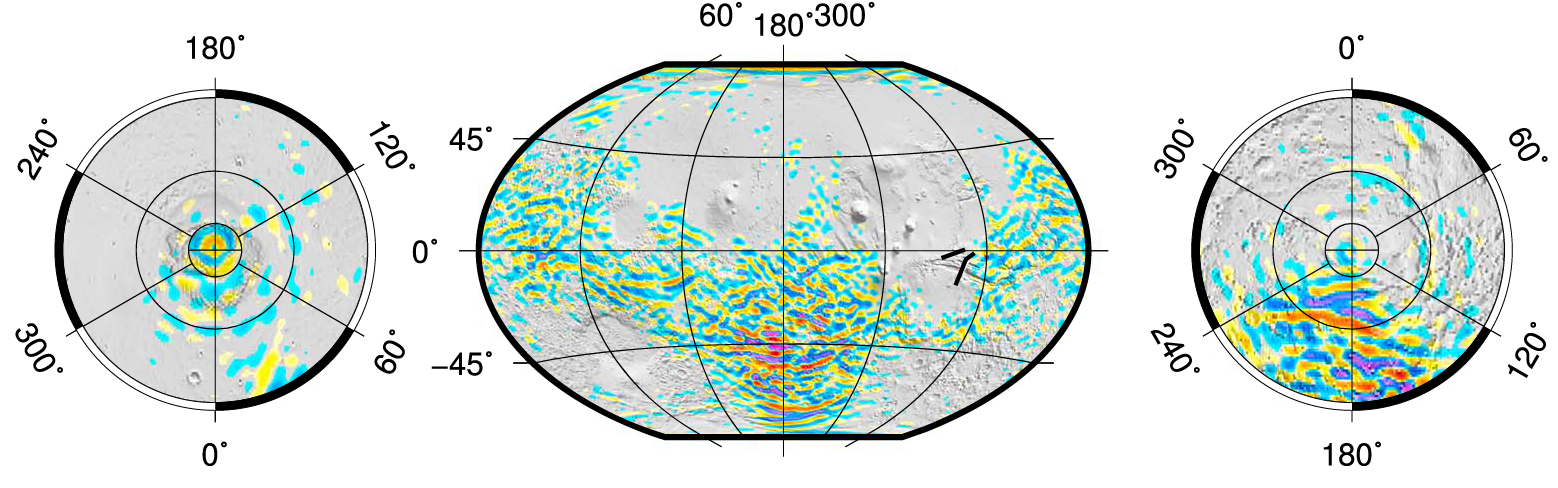
The Martian crust recorded the magnetic field generated in its core (likely a dynamo effect) very early in the planet's history. It likely started very soon after planet formation at 4.5 Ga (billion years). Not sure when it stopped, perhaps 3.5 billion years ago. It is also possible that it stopped earlier, then another field-generating mechanism started, resulting in new magnetic anomalies in the crust. This remanent field has been measured by MGS and MAVEN.

The Martian dynamo
At 4.5 Ga, the (roughly) northern hemisphere of Mars subsided relative to the southern hemisphere by 2 km. This is referred to as the Martian dichotomy. There is no consensus as to the origin of the dichotomy. Some advocate a giant impact, named the Borealis impact because today most of the impact structure would be filled by a geologic formation at the surface called the Borealis Formation. Although the event would have been powerful enough to almost shutter the planet, it did not.Banded magnetic anomalies
For what we know, though at smaller scale, is that impact basins have associated circumferential magnetic anomaly patterns, for instance as an effect of hydrothermal circulation along basin ring faults, as at the Chicxulub basin in the Yucatan peninsula in Mexico. Magnetic minerals would crystallise in these fractures when fluid temperature decreased to their Curie point, generating the circumferential anomalies. On Mars, the radial (vertical) component of the remanent magnetic field, as expressed in the magnetic anomaly patterns, is banded.Crustal magnetisation as a response to a giant meteorite impact
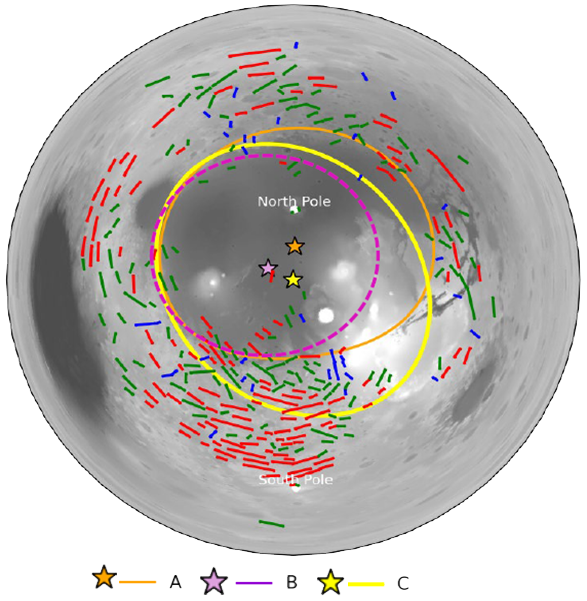
In an NCN-funded project, we found that a significant proportion of these banded anomalies are parallel to an ellipse. It was shown that if a giant impact occurred, based on inversion of gravity and topography data Andrews-Hanna et al. (2008) and numerical modelling Marinova et al. (2008) that the Borealis impact should have been oblique, resulting in an ellipse. We found that the ellipse as from the banded magnetic anomaly patterns has a centre close to impact centres inferred from other datasets in earlier works.We interpret (Orlanducci et al., 2025, and work in progress) that the majority of the banded magnetic anomalies on Mars formed in response to a giant impact at 4.5 Ga.
Hydrothermal processes may have generated the magnetic minerals and oriented the magnetic fabric. Later fluid circulation may have also cancelled the magnetic fabric locally along the hydrothermal fractures, by desorganising the orientation of the magnetic grains, as we could show at the Danakil plate boundary in East Africa (Choe et al., 2025).