Volcanic seepage on Mars from ExoMars Trace Gas Orbiter?
Last updated:
This is a funny finding that we reported at the Europlanet Congress in September 2025 are in the process of publishing. It involves the scientific teams of the ATmospheric Chemistry Suite (ACS) and the Color and Stereo Surface Imaging System (CaSSIS) of the Trace Gas Orbiter (TGO) of the ExoMars program of the European Space Agency (ESA), which orbits Mars and gives science data since 2016. The Nadir and Occultation for MArs Discovery (NOMAD) spectrometer has joined the party - but results wwill be in a later stage. In short, ACS made weird observations of hydrogene chloride (HCl) above a volcanic rift zone on Mars.
What can this be?
We disclosed some results at the Europlanet Congress (EPSC) in Helsinki in September 2025.



On HCl in the Martian atmosphere during northern summers
Hydrogene chlorine (HCl): a major trace gas for the TGO spacecraft
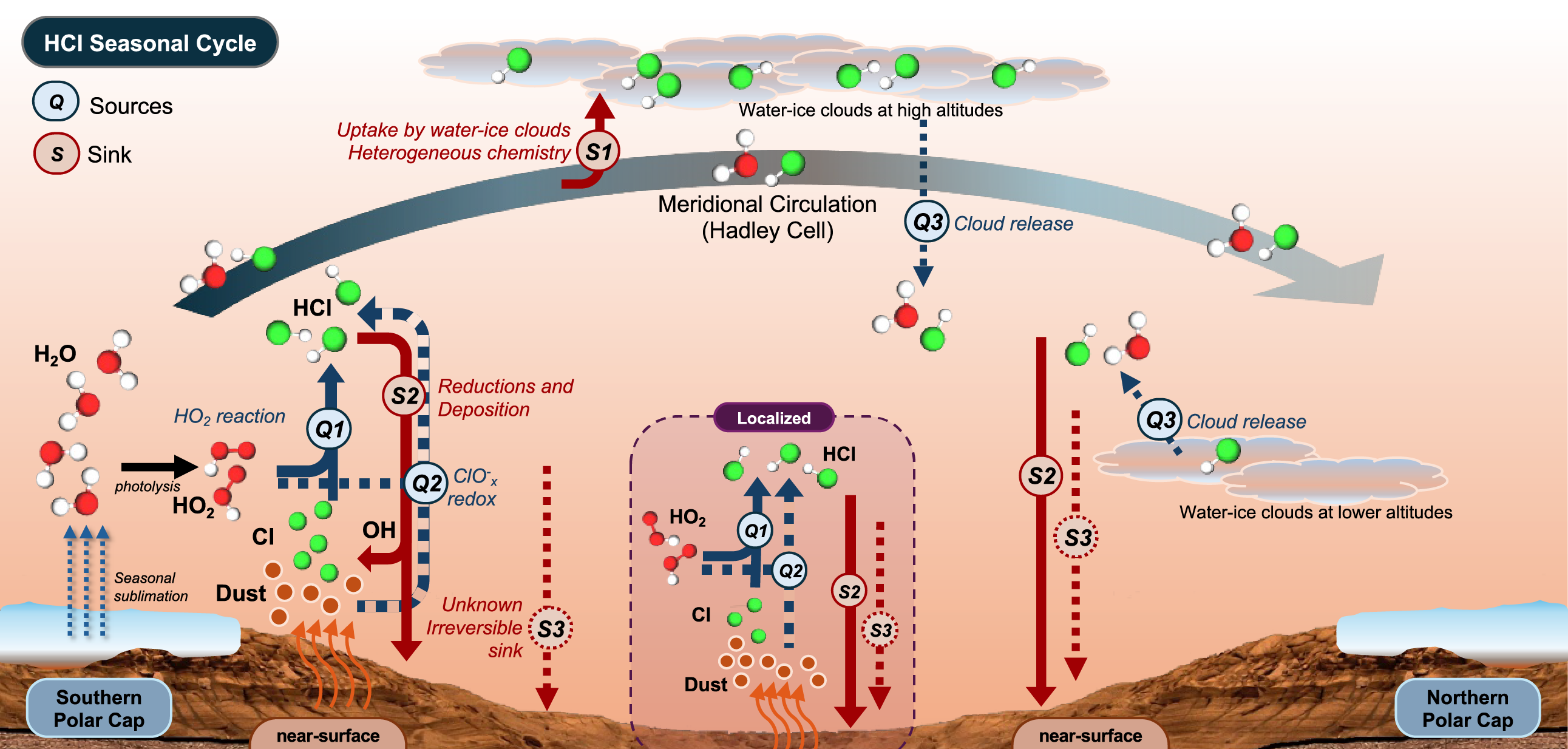
One of the primary objectives of the ExoMars Trace Gas Orbiter (TGO) mission was to search for previously undetected trace gases that could be diagnostic of active geology or a biosphere [2]. The first such gas was hydrogen chloride (HCl) [3], detected with the mid infrared channel of the Atmospheric Chemistry Suite (ACS MIR) [4]. The presence of HCl on Mars was expected to be an indication of active magmatic processes. However, HCl was found to be widespread and we quickly identified a pronounced seasonal cycle in HCl [5-8]. These aspects indicated that its behaviour was mainly governed by strong photochemical interactions linked to water vapour. The original source of HCl, its sinks, and how its abundance is regulated over time remain a mystery.
Which source of chlorine in the HCl atmospheric cycle on Mars?
ACS is a suite of three spectrometers used to study the composition and chemistry of the Martian atmosphere in detail. ACS MIR is a cross-dispersion spectrometer operating in solar occultation geometry, which provides excellent sensitivity to weak absorption signatures and vertical structure. HCl was discovered in data from shortly after the 2018 Mars Global Dust Storm (solar longitude 220° in Mars year 34) and its signal disappeared shortly after the late season storm that occurred around solar longitude (Ls) 220°. A similar trend has since been observed in the following Mars years (MYs), with HCl returning alongside warm atmospheric temperatures, increasing water vapour content, and dust activity - all driven by southern summer occurring at perihelion. Modeling work to define HCl behaviour [9-11] leave the unanswered question: if HCl has a limited photochemical lifetime, what sources are replenishing atmospheric chlorine?Exceptional observations
In MY35, two exceptional observations were made in northern summer, near aphelion, to the north of Alba Mons, on the northern side of the elevated Tharsis plateau [4,6,7]. No other HCl detections have been made during the aphelion period, during southern fall and winter, during which the entire Mars atmosphere is characterised as cold and dry, and has limited dust activity. We performed a dedicated search for HCl using ACS in MY 37. As presented here, several observations detected HCl again in the Alba Mons area. The atmospheric conditions below 10 km are not inconsistent with those during perihelion, with the northern summer raising atmospheric temperatures, introducing water vapour, and limited dust aerosols. However, HCl detections remain rare, it is not well-mixed, and its residence time is short. Many ACS observations made at other latitudes and other times exhibit very good viewing conditions and similar atmospheric states, but no HCl absorption features.
A source of HCl within the crust?
This leads to the idea that perhaps there is a localized source of HCl over the region. We have used high resolution imagery recorded by TGO's Colour and Stereo Imaging System (CaSSIS), Mars Reconnaissance Orbiter's (MRO's) High Resolution Imaging Science Experiment (HiRISE), and MRO's Context Camera (CTX) to characterise the terrain beneath the ACS HCl detections over the Alba Mons region. Below some of the detection sites, we identified linear swarms of tens to hundreds of fissures less than 1 m wide and up to hundreds of meters long, unreported in previous works, which affect the ice-rich latitude-dependent mantle and the periglacial polygons east and north of Alba Mons. They are therefore thought to be younger than 1 million years [13]. Some are located on top of linear uplifts marked by bright and dark deposits, denoting possible diffusion of chemically modified subsurface fluids to the surface. The swarms are aligned with Tantalus Fossae, and in particular, Phlegeton Catena, above which similar fissures are observed and the other HCl detections were made.Cited references
1. Mège, D. et al. (2015). On HCl in the Martian atmosphere during northern summers. EPSC-DPS Joint Meeting 2025, Helsinki, Finland, EPSC-DPS2025-985. EPSC-DPS2025-985.
2. Vago, J. et al. (2015). ESA ExoMars program: The next step in exploring Mars. Solar Syst. Res., 49(7), 518–528.
3. Korablev, O. et al. (2021). Transient HCl in the atmosphere of Mars. Sci. Adv., 7(7), eabe4386.
4. Korablev, O. et al. (2018). The atmospheric chemistry suite (ACS) of three spectrometers for the ExoMars 2016 trace gas orbiter. Space Sci. Rev., 214(1), 7.
5. Olsen, K. S. et al. (2021). Seasonal reappearance of HCl in the atmosphere of Mars during the Mars year 35 dusty season. Astron. Astrophys., 647, A161.
6. Aoki, S. et al. (2021). Annual appearance of hydrogen chloride on Mars and a striking similarity with the water vapor vertical distribution observed by TGO/NOMAD. Geophys. Res. Lett., 48(11).
7. Olsen, K. S. et al. (2024b). Relationships between HCl, H2O, aerosols, and temperature in the Martian atmosphere: 1. Climatological outlook. J. Geophys. Res., 129(8).
8. Olsen, K. S. et al. (2024b). Relationships between HCl, H2O, aerosols, and temperature in the Martian atmosphere: 2. Quantitative correlations. J. Geophys. Res.: Planets, 129(8).
9. Krasnopolsky, V. A. (2022). Photochemistry of HCl in the Martian atmosphere. Icarus, 374, 114807.
10. Taysum, B. M. et al. (2024). Observed seasonal changes in Martian hydrogen chloride explained by heterogeneous chemistry on atmospheric dust and ice. Astron. Astrophys., 687, A191.
11. Streeter, P. M., et al. (2024). Global distribution and seasonality of Martian atmospheric HCl explained through heterogeneous chemistry. Geophys. Res. Lett., 52(6).
12. Faggi, S., Aoki, S., et al. (2025). Following the HCl cycle over three Martian seasons in Mars year 36. J. Geophys. Res.: Planets, 130, e2025JE009105.
13. Schon, S. C. et al. (2012). Recent high-latitude resurfacing by a climate-related latitude-dependent mantle: Constraining age of emplacement from counts of small craters. Planet. Space Sci., 69, 49–61.